Links for March 22nd, 2026

This week from me at TVO: a look at the economic problem facing Sault Ste. Marie, where everyone agrees that the local steel mill must be protected — but keeping it alive as a sustainable economic concern means, in this case, that it needs fewer workers. Also: a rant about the government proposing to gut Ontario’s freedom of information law:
Finally, there’s a compelling argument that the internal work of Ontario’s government should be held to a higher standard even if we think it’s okay that smaller provinces keep their voters more thoroughly in the dark: Ontario is (sorry, everyone else) bigger and more important. With 14 million of the country’s 37 million people, and nearly 40 per cent of its GDP, even in cases where Ontario’s government sticks purely to areas of provincial jurisdiction it can have national effects. If you want a clear case of this: the recent cramdown on national immigration is largely a reaction to the effects of Ontario’s post-secondary education policies: universities and colleges in this province tried to offset lost tuition revenue by cashing in on foreign students, causing an unplanned and uncontrolled surge in immigration even as the province simultaneously presided over a crisis of collapsing new homebuilding. Those are all areas of provincial jurisdiction, but they had national impacts. That kind of power demands scrutiny, and indeed a greater degree of scrutiny than we’d necessarily demand of smaller provinces where the effects of their decisions simply won’t be felt further afield.
And even if none of that were true, even if it was obviously and unambiguously better to adopt the rules of other provinces as our own, it still wouldn’t explain or justify making the changes retroactive to nullify the lawful demands Ontarians had already made.
On the podcast, I spoke with Isaac Callan of Global News about those same proposals and why they matter. Steve and I also discuss some law & order items from the government and municipal election year items.
Elsewhere:
Doug Ford has utterly wasted an extraordinary mandate [Globe and Mail]
Mr. Ford has utterly wasted an extraordinary mandate. He could have used the past eight years to lay the foundation for radical policy changes: to perhaps reimagine how we structure health care in Ontario, or fund education, or conceive of what it means to own a home in this province. A man who was truly “for the people” would have done that with unbridled transparency, too.
Instead, Mr. Ford is a mattress salesman waving silk pillowcases and bamboo sheets in front of your face, hoping that you won’t notice that the box spring is being held together by thumbtacks.
How the Housing Market Split in Two [Agglomerations]
The current divergence began in earnest in 2022. By 2024, new homeowners were spending 26 percent of their income on housing, compared to 20 percent for existing homeowners — a six-percentage-point gap, the largest in nearly 40 years. Although new homeowners spent a slightly larger share of their income on housing at the peak of the housing bubble in 2007 (28 percent), the gap with existing homeowners was smaller (four percentage points). Even at the height of this century’s other housing affordability crisis, the housing cost burden was less unequal…
Since 2019, the real average downpayment has risen by more than 29 percent, while inflation-adjusted average and median household incomes have flatlined. As a result, buyers need to save for significantly longer just to enter the homeownership market.
Austin’s Surge of New Housing Construction Drove Down Rents [Pew]
Austin city and metropolitan-area construction has surged since 2015, helping to make the Texas capital one of the only major cities where rent has fallen since the pandemic. Asking rents decreased 4% in both the city and the surrounding suburbs from 2021 to 2025. (See Figure 1.) In real terms, inflation-adjusted rents in the city of Austin fell 19% from the 2021 average to the 2025 average. This trend contrasts favorably with the national rent growth of 10% and the 6% increase in high-growth Texas.
In Austin and its metropolitan area, rents in large apartment buildings decreased by 7% from 2023 to 2024—the greatest drop in any U.S. metropolitan area. This decrease was most pronounced (-11.4%) in Class C buildings, the older, non-luxury structures that offer affordability for renters at the lower end of the income spectrum. In Class A buildings, which are newer and more high-end, rents fell only 2.6%.
A Danish Fix for U.S. Mortgage Lock-in? [SSRN]
We study Danish fixed-rate mortgage contracts, which are identical to those in the United States except that borrowers may repurchase their mortgages at market value. Using Danish administrative data, we show that households actively buy back debt when mortgage prices fall below par and that household mobility is largely insensitive when existing mortgage rates are below prevailing market rates-unlike in the United States, where moving rates fall sharply as rates rise. We develop an equilibrium model that explains these patterns and show that introducing a repurchase-at-market option into U.S. mortgages substantially reduces interest-rate-induced lock-in with limited effects on equilibrium mortgage rates.
Why Silicon Valley hasn’t done more for most Americans [Slow Boring]
Americans sometimes look with envy on the rapid economic growth achieved in China during this period. But if you look at Shenzhen or any other major Chinese city, what you see is dramatic physical transformation across the course of the 21st century. That’s precisely what American public policy has been hostile to, not just in the Bay Area but almost everywhere that isn’t an unincorporated area on the fringes of a Sunbelt metro area.
To have a broad-based economic boom, we need a boomtown.
How health systems learn to fail [Canadian Journal of Emergency Medicine]
We praise the nurse who skipped breaks, the physician who stayed late, and the team that “made it work” despite impossible conditions. These stories are emotionally appealing. They are also misleading. In any high-reliability system, repeated heroics signal design failure.
The Tesla Influencers Leaving the ‘Cult’ [Wired]
He recalls going after auto industry journalists and “really anybody else who was remotely negative about Tesla—I was insufferable and just all over those folks.” Banning thought these skeptics were “suffering from misinformation” and “couldn’t see the good that Elon was doing.” He also knew there were outspoken Tesla short-sellers who wanted to see the company tank, and when he engaged with anti-Tesla opponents on X, he regularly accused them of holding these market positions…
From then on, Banning was a sworn enemy of the Teslarati, even though he still loves his Model X and rarely speaks badly of Tesla itself. He made amends to some of the critics he used to attack and continues to occasionally share cute Frunk Puppy photos. “It was kind of like a cult, but like a goofy cult, and something changed over time,” he says of his old community. “When Elon took more of a godlike status, and then when he took over Twitter [in 2022] and everything, then what you saw is everybody—they don’t have an opinion about anything unless it’s Elon’s.”
US told Turkey war on Iran would end in just four days, expert says [Middle East Eye]
“Turkey and some of its allies were told, through official channels, that this operation would take days and be completed in four days,” Aydintasbas, a fellow at the Brookings Institution, said in an interview with the Serbestiyet news site.
“You cannot tell a Nato ally that you have made a four-day plan and then extend the operation to 14 days. In a sense, this was also a betrayal of the regional countries.”
None of These People I Insulted Want To Die For Me in The Strait of Hormuz? [Forever Wars]
Thirty years ago, while basking in the dawn of U.S. hyperpower, imperial policymakers liked to say that “superpowers don’t do windows”—that is, the unglamorous, menial tasks of hegemony, which ought to be performed by client states. We are a long way from that now. The Iraq War (and then the Afghanistan surge) showed that even at the height of U.S. unipolarity, there were serious political limits to the participation of partner militaries in unpopular American wars of choice. Now, at the historical end of U.S. unipolarity, there simply was never going to be any appetite to save the Americans from their own mistakes…
I am not saying there should be a better, more competent unprovoked aggression against Iran. The war is unjustifiable, even were it winnable, which it does not look to be. I am saying that the Trump people were unwilling to do the basic work of preparing for the foreseeable consequences of their actions, work typically performed by belligerents who know how to, like, win. I am saying that not only is their agenda loathsome, they do not know ball.
Grand Delusion [Unpopular Front]
I would bet quite a bit of money that a good deal of Trump’s supporters don’t even know Andrew Jackson is the guy on the twenty. They had no such expectations. They are smarter than Caldwell and Ahmari in a way because they elected Trump because he seemed like an unscrupulous gangster and thought that’s what the country needed. They still do: I’m not sure the war is as unpopular with Trump’s base as Caldwell wishes; they like it because Trump tells them to. That’s because they aren’t hardscrabble Jacksonian democrats chewing on corncob pipes and leaning on their rifles; they are addled boomers who watch Fox News for 12 hours a day. And, I’m sorry: many, many Americans did very much expect Trump’s character flaws to endanger them in the realm of foreign policy. For example, this American. It was extremely easy to see this coming…
It’s exactly as Arendt observed when she noted how intellectuals in Germany “made up ideas about Hitler…Completely fantastic and interesting and complicated things.” Just relax—I’m not saying Trump is literally Hitler; I’m saying that this is the same failure of judgment Arendt spoke of: it’s the same incapacity to apply the correct concepts to the situation, namely that the person in question is a criminal lunatic.
William Gibson vs Margaret Thatcher [Cory Doctorow]
“The street finds its own uses” is a statement about technopolitics. It acknowledges that yes, there are politics embedded in our technology, the blood in the machine, but these politics are neither simple, nor are they immutable. The fact that a technology was born in sin does not preclude it from being put to virtuous ends. A technology’s politics are up for grabs…
But there’s a left version of this, its doppelganger: the belief that a technology born in sin can never be redeemed. If you use an LLM running on your computer to find a typo, using an unmeasurably small amount of electricity in the process, you still sin – not because of anything that happens when you use that LLM, but because of LLMs’ “structural properties,” “the way they make it harder to learn and grow,” “the way they make products worse,” the “emissions, water use and e-waste”
The Disappearing Off-Ramp in Iran [The Atlantic]
Trump launched the war because he believed that Iran was weak and that he could quickly win. Many wars start that way. Few end as expected. Now, just over two weeks in, the window for declaring victory is closing. He can try to escalate, as some of his predecessors did in Vietnam, Iraq, and Afghanistan, but that is no guarantee of success. Unless he gets lucky, his real choice may be whether to keep fighting or try to negotiate a messy compromise. Either way, the war Trump chose to start is no longer entirely his to control.
The new world war [The New Statesman]
The damage to energy storage, terminals, refineries and pipelines around the region threatened to plunge the world into another recession, toppling governments, immiserating millions. They would learn what it felt like to be Ukrainian. They may come to understand that the Ukrainian experience is the key to global security now. The world would transform again, and not necessarily to our advantage in sleepy, barely defended Britain. I began to fear that we would not understand the new reality until it was crashing down towards us from a hostile sky.
Slowly, I came to believe in what Mykhed had told me in Kyiv. “People think this is the third act,” he’d said. Whatever this war was – a war for independence, a proxy war fought between empires, a third world war – it was nowhere near over. It was spreading uncontrollably, violently, like a germ. I think about Mykhed’s words all the time now. “Are you ready to be in the first act?” That is now the question for Europe and its fearful, cocooned leaders looking out of their windows as the street lamps begin to flicker across the continent.
Questions and Predictions [Syncretica]
China has ample crude stockpiles and product processing capacity: I discussed this at length some time ago here. Australia is going to need to do a deal here to get access to that, likely via the Singapore refining system. Japan and Korea have stockpiles, but they need them for their own use. The other option of course is doing whatever Iran wants to get access to products via the channel that India is using for LPG. China’s ask is going to be something along the lines of pushing out US bases and the like - those bases we were told we needed for our security and economic security - which of course has not worked out terribly well. I dislike this more than most but if you depend on a hegemonic power for global order that enables complex fossil fuel supply chains then this is the risk you run and the price you end up paying when the hegemon gets run tweet to tweet, podcast to podcast. Decarbonization at breakneck speed cuts this risk but takes time and 1mm electric vehicles save about 35,000 barrels of oil per day. There is no way 450mm+ EVs can be deployed in the next year, sadly.
US furiously seeks to avert potential monthslong closure of Strait of Hormuz [CNN]
“One of the core conundrums of this conflict is the Iranians have real leverage with this, and there’s not an obvious fix for it,” an intelligence official said of efforts to reopen the strait.
A recent internal assessment from the Defense Intelligence Agency that was circulating inside the Pentagon in recent weeks determined that Iran could potentially keep the passage shut for anywhere from one to six months, four sources familiar with the document told CNN. But White House and Pentagon officials insisted that the assessment — particularly the longer end timeframe, which some consider a worst-case scenario — was not being seriously considered.
The Big Story Not Being Acknowledged [Phillips’s Newsletter]
The US, if it cannot fight an already militarily degraded Iran effectively, has no chance to oppose China in the western Pacific or to defend Taiwan or even Japan for any period of time. It lacks the capabilities, skills, strategic mindset and thinking military for such a fight and the Chinese would be able to produce military force that would exceed Iranian capabilities in terms of quality and mass by a factor almost too large to contemplate.
In War and Power I wrote my conclusion about what might happen in a war involving the US and China in the western Pacific. My ultimate point was that while the US might do well at first, because of certain advantages, the Chinese had a much greater likelihood of prevailing over time because of their much larger ability to generate military force and sustain operations. In a nutshell, the US might win some battles at the start, but China was in a better state to win the war. I wrote a substack and Atlantic article about this idea back in October/November, if you want to read more.
A Strategic Failure in Iran [CATO Institute]
The Trump administration has failed to accomplish the two principal aims of this war. Iran’s nuclear program is not destroyed, and the regime remains intact. Instead, the president has placed the United States on the path to another forever war in the Middle East. Tehran is prepared for a prolonged war of attrition and intends to raise the political, economic, and human costs until they become untenable for the United States. In particular, the Trump administration greatly underestimated Iran’s ability to disrupt the global energy market so quickly, and these disruptions are likely to impact the market even after the war ends. Further escalation by Trump will only exacerbate the problem and further entangle the United States. Washington is charging ahead without a strategy and risking costs it cannot afford.
Can Cuba’s Regime Survive as US Chokes Oil Supplies? [Bloomberg]
A series of crises in recent decades have driven waves of Cuban migrants to US shores. In 1980, more than 125,000 Cubans arrived in Florida over the course of just a few months in what was known as the Mariel boatlift. The current exodus from the island, which began during the Covid-19 emergency and soon surpassed Mariel, shows no signs of abating. If the government in Cuba collapses entirely, it could spark a still greater migration wave and a humanitarian crisis on Florida’s doorstep.
A failed Cuba could also destabilize other parts of the Caribbean and Latin America. And there’s no telling how China and Russia might react to the fall of one of their longest-standing ideological allies in the Western Hemisphere.
Democrats who want more v. Democrats who want less [Men Who Yell At Me]
It’s clear where my bias lies here. I believe we should ask for more. Even if it isn’t always a winning proposition. Because it’s not always about winning but about shifting the party and the conversation back to a place of value and vision. What good is power for power’s sake if you are going to do nothing with it to help anyone?
I think we should yank that Overton window back toward the side of an inclusive future. I think a lot about the old Republican “joke” that Hillary Clinton wanted a “taco truck on every corner” and how that was a far more compelling and interesting vision for America than anything her campaign ever came up with.
Optimism In An Age Of Superstition And Decline [Off Message]
If Democrats have a chance to rebuild in 2029, it will make 2009 and 2021 look like child’s play. The economy, the world order, even the viability of the American state will be on the line. They will thus surely see the value in making a clean and explicit break with the way we used to do things.
Leaders who don’t want failed legacies will thus move aggressively. They’ll have to. I won’t recapitulate all the many things they’d need to accomplish, and quickly, to put the country on an even keel. You can mine the archive for those. Suffice it to say they include accountability for public corruption, truth and reconciliation, court reform and other democracy enhancements—both so that the U.S. can govern itself, and to prove to the world that we’re not just one election away from another brush with despotism.
Adventures in Slopulism [Public Comment]
In the year immediately following Prop 13’s passage, property tax revenues fell 60 percent, which set off a scramble for new income streams. The state compensated for the loss of all that tax revenue by becoming increasingly reliant on income taxes. Income taxes in California are pretty progressive, meaning that wealthy households pay a larger share of their income than most middle- and lower-income households. Though California is widely believed to be a high-tax state, a 2024 report from the Institute on Taxation and Economic Policy found that “[o]nly the top 5 percent of California families pay tax rates that are more than 2 percentage points higher than the national average.”
Which sounds nice, especially when combined with California’s fairly generous social safety net. But incomes for the top five percent are volatile; the state can be flush one year and deep in a hole in the next, depending in part on whatever’s going on in the tech industry. It would be an exaggeration to say that the difference between a massive surplus and a massive deficit depends on the health of tech executive Christmas bonuses in any given year, but it’s an exaggeration that gets uncomfortably close to the truth.
CNN’s “100% MAGA Trump approval” segment omits key nuance for virality [Strength in Numbers]
That’s why it’s important to highlight erosion in support for Trump and his actions among what I’ve been calling “soft partisans“ — or non-MAGA Republicans. According to the latest Economist/YouGov polling data, 59% of Republicans identify as MAGA supporters. But the other 40% of the party is where the slippage is: YouGov reported last May that net approval of Trump among non-MAGA Republicans was down 40 points since inauguration day, and that figure is probably even larger now. About 27% of non-MAGA Republicans now hold a somewhat or very unfavorable view of Trump. So if there is a “MAGA civil war,” this is where it is happening — not among the 100% who selected into the label, but among the rest of the party beyond the MAGA core.
The energy security fallout [Electrotech Revolution]
The lasting consequences: This crisis will accelerate what was already underway. Asia, which imports 40% of its oil through the Strait of Hormuz, now faces the same reckoning Europe did in 2022 — but with increasingly cost-competitive electrotech alternatives available. The bull case for LNG as Asia’s transition fuel is now much weaker. And peak oil has been brought sharply forward: the International Energy Agency has already cut its 2026 demand growth forecast, and the peak it previously put at 2029 may already be here.
BYD Showrooms Are Bustling Across Asia After Iran Oil Shock [Bloomberg]
At a BYD Co. car dealership in Manila’s financial district, demand for the Chinese company’s electric vehicles is so high that Matthew Dominique Poh said he’s seen a month’s worth of orders in just the past two weeks.
“Clients are replacing units in favor of EVs because of the oil price hikes,” said Poh, who’s been a salesman at the dealership for the past seven months.
China Has Already Notched its First Major Win From the Iran War [Bloomberg]
When Erica talked about the benefits to Chinese industry, she was kind of talking about it as a long- or medium-term prediction, that this war would would accelerate this structural trend of countries reducing oil imports by substituting it with Chinese energy tech The only thing she got wrong is that this isn’t just some likely outcome at some point in the future. China is getting its first win right now.
Difficult to overstate just how world-historically dumb it is to start an entirely optional oil shock at a time when your primary geopolitical rival has cornered the market on alternatives to fossil fuels. Oh hey what’s this:
China makes energy security ‘reunification’ offer to Taiwan amid Middle East war [Reuters]
Chen Binhua, a spokesperson for China’s Taiwan Affairs Office, told reporters in Beijing that “peaceful reunification” would bring better protection of Taiwan’s energy and resource security with a “strong motherland” as its backing.
“We are willing to provide Taiwan compatriots with stable and reliable energy and resource security, so that they may live better lives,” he said, responding to a question about Taiwan’s energy supplies during the war in the Middle East.
Data Centers Overtake Offices in US Construction-Spending Shift [Bloomberg]
For Turner, a construction giant responsible for supertall office skyscrapers, sports stadiums and cultural venues around the globe, data centers are commanding more of its bandwidth. The company completed $9.4 billion of the projects last year, more than five times its 2020 total. Last month, Turner announced it was chosen as one of the contractors on a $10 billion data center for Meta in Indiana.
Tech companies’ needs for AI processing facilities have made data centers the latest darling of the real estate industry. The properties are figuring heavily into portfolios of major investors such as Blackstone Inc., Brookfield Asset Management Ltd. and KKR & Co., on a bet that long-term demand for computing power will continue to grow. At the same time, office development has slowed as cities across the US contend with vacancies that have piled up since the Covid lockdowns.
Nevada utility to Lake Tahoe: Find electricity elsewhere [CalMatters]
A utility serving 49,000 Lake Tahoe customers has a little over a year to find a new source for 75% of its power. Liberty Utilities, one of California’s three smaller investor-owned power companies, alerted regulators this month that its main power supplier won’t continue its contract after May 2027.
Liberty, whose territory sits on the border of California and Nevada, generates about 25% of its power from solar facilities in Nevada. The rest is purchased through Nevada-based NV Energy, which said that it wouldn’t be able to continue this arrangement because of its “own resource needs,” Liberty told regulators this month.
What Paul Ehrlich’s Fear of Scarcity Did to American Politics [The Atlantic]
Today both the left and the right still act at times as if Ehrlich’s dystopia lurks just around the corner. Progressives remain divided over whether economic growth can truly go hand in hand with environmental protection, a major political liability when many voters say that they are struggling to achieve the standard of living they want. Many conservatives, meanwhile, view the world as a zero-sum game in which Americans must fight foreign powers and immigrants to keep our slice of a pie that isn’t growing. Both of these mindsets are children of the era that produced The Population Bomb.
Grieve Ehrlich’s passing or don’t (I am not devastated by it) but Elon Musk’s killing of children in the developing world is much more direct and I decline to stop being angry about that but it has already seemingly been memory-holed.
When did humans arrive in the Americas? A new study reignites the debate [National Geographic]
Monte Verde’s discovery was a scientific sensation because radiocarbon dates of wood fragments and other organic materials found near the stone tools suggested the site was around 14,500 years old. That hinted it could be 1,500 years older than North America’s Clovis culture, which had been the long-standing benchmark for the earliest human presence in the Americas, distinguished by fluted spearpoints first found in New Mexico…
Their analysis of the geology suggests that the stream changed course during a hot and dry climatic phase, around 10,000 years ago, says co-author Latorre, a paleoecologist at the Pontifical Catholic University of Chile. When sea level dropped, the stream cut a deeper course through the hillside, picking up well-preserved fragments of Ice Age wood and other organic materials, exposed by glacial retreat, and redepositing them near the archaeological site. This, they argue, may have contaminated earlier efforts to date the site.
On Critical Liberalism [The Novice]
Adam Smith, father of capitalism, rejected economic abundance where it bore the marks of a whip. He never lost sight of what makes commercial society so essential: freedom from domination and fear. This is “by far” the most important consequence of commercial orders, bringing liberty and security to those beset by conflict and a “servile dependency upon their superiors”. That promise of liberation was exactly what the enslaved had been denied…
Yet emancipatory zeal carries its own risks. It becomes all too easy for the revolutionary, the humanitarian, and even the liberal technocrat to disregard the cries of those they would liberate. The Wealth of Nations famously warns against the “man of system” who treats people as so many chess pieces. Smith isn’t rejecting systematic reform; the book is nothing if not an excavation of the sometimes obvious, often obscure sources of immiseration that are within our power to change. Rather, as Jacob Levy has argued, Smith is stressing the need for reform to work with, and not against, human attachments, and cautioning against promises to sweep aside the social order. Smith would have us seek fewer Cromwells and more Wilberforces.
I had a good long laugh at this post from Adam Sternbergh on Bluesky:
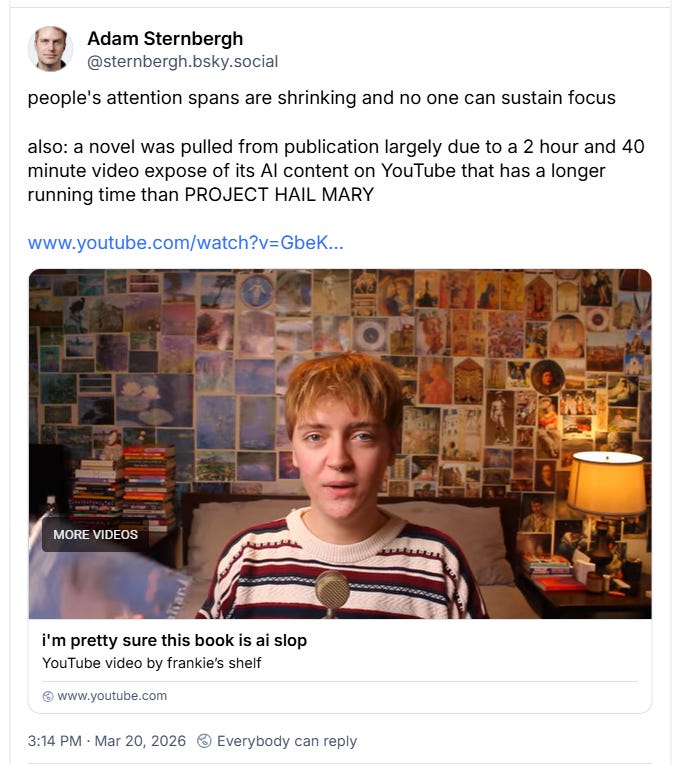
On that note, here’s an hour about how your car engine works and why the oil pressure warning light is the one you really, really can’t ignore:
And here’s 103 minutes on the collapse of the Bronze Age Mediterranean system:
And finally here’s 83 minutes on what the US war on Iran is doing to global oil markets:
One point in particular from Rory Johnston that I want to highlight is that we’ve been in the midst of a massive buildout of AI data centres and these are, as Johnston says, the most energy-intensive industry yet created by humankind. They are particularly exposed to the production of natural gas in at least three ways: conventional data centres are powered by the electricity grid, where natural gas plays the price-setting role; newer data centres might have their own off-grid power but they’re still very likely consumers of natural gas and thus also exposed; and the process to make all these chips in the first place depends on the availability and use of helium, a byproduct of natural gas extraction.
So quite aside from the direct effects of all this chaos, there’s a pretty big question: what happens when the load-bearing pillar that’s been holding up the US economy gets sucker-punched by massive energy costs and a shortage of one of its primary inputs?
Still time for us to avoid finding out but I don’t like our chances.