Links for May 10th, 2026

This week at TVO: I am back on one of my most radioactively hot takes by the standards of Toronto politics, arguing for the establishment of municipal political parties:
The problems with the absence of political parties don’t end on election day, since the results are a system where it’s functionally impossible for voters to get what they vote for. A mayoral candidate might run on a city-wide platform but the moment they’re sworn in they’ll run face-first into the buzzsaw of a council that a) has its own ideas and b) doesn’t need the mayor’s permission. This has regularly made my job as a political journalist more fun and interesting than it otherwise would have been, but entertaining political journalists is not, in fact, the primary consideration in how we structure institutions. Toronto’s council structure makes a city of 3 million people harder to govern and, more importantly, harder for voters to fix.
Making municipal elections de jure partisan instead of merely de facto could only possibly sound radical in Toronto, a city that often tries its best to be as reactionary and conservative as possible. We are not just an outlier among other global big cities (London, Berlin, New York, Paris, Rome — all governed by partisan councils!) even Toronto’s comparable cities in Canada have established political parties in Vancouver and Montreal.
Also, an interview with Liberal MPP Lee Fairclough, who is running to be the party’s next leader.
On the podcast this week, Steve and I discuss Marit Stiles’ promise to call a public inquiry to investigate the Ford government if she wins powers and her warning that the premier might find himself behind bars.
Elsewhere: I imagine we’ll be discussing this on the podcast this week…
Ahsanul Hafiz wins Scarborough Southwest Ontario Liberal nomination, beats Nate Erskine-Smith [CBC]
Erskine-Smith ran for the nomination as part of his second bid to become Ontario Liberal leader. He finished a strong second to former leader Bonnie Crombie in the 2023 race and was a vocal critic of her ahead of the review that led to her resignation last September.
While the future of that bid remains unclear, Erskine-Smith raised the possibility of challenging the results of Hafiz’s win.
Things getting real over in UK politics:
Rayner issues ‘last chance’ warning to Starmer and backs Burnham to return [BBC]
Angela Rayner has warned that Labour faces its “last chance” after heavy election losses this week, as she backed Andy Burnham to return to Westminster.
In a statement following Labour’s disastrous performance at the polls, the former deputy prime minister said the party had been wrong to block the Greater Manchester mayor from standing as an MP earlier this year.
Babies Are Bleeding to Death as Parents Reject a Vitamin Shot Given at Birth [ProPublica]
In almost every case, the babies’ deaths could have been prevented with a long-standard vitamin K shot. But across the country, families — first in smatterings, now in droves — are declining the single, inexpensive injection given at birth to newborns to help their blood clot.
Many of them are doing so out of a well-meaning but ill-informed abundance of caution. In the hopes of safeguarding their newborns from what they see as unnecessary medical intervention, they have shunned fundamental and scientifically sound pharmaceutical intervention. The trend is also fueled by a contradictory pairing: families’ fierce desire to protect their babies and a cascade of false information infused into their social media algorithms.
Genuinely one of the saddest articles I’ve read recently. I cannot fathom being so down the rabbit hole that you’re rejecting a Vitamin K shot for your newborn.
Chinese solar exports double in a month to hit record high amid energy crisis [Ember]
The March data from the Chinese customs authority provides the first insight into the global response to the energy crisis. Analysis by Ember, with data published openly in the China Solar PV Export Explorer, reveals that the record 68 GW of solar exports is equivalent to Spain’s entire solar capacity, surpassing the previous record set in August 2025 by 49%.
From March:
China’s Solar Industry Is in Upheaval—The Effects Will Be Global [CSIS.org]
Price wars and margin compression have forced industry leaders—including Jinko Solar, Trina Solar, and JA Solar—to report significant losses. These firms, along with LONGi Green Energy and Tongwei—the industry’s top five—slashed their workforce by over 30 percent in 2024. The market is facing industry consolidation and exits not seen in over a decade, as over 40 smaller firms have filed for bankruptcy, been acquired, or exited the market.
Donald Trump rescued the Chinese solar power sector from crisis. Incredible geopolitical strategy at work.
Spain just became one of Europe’s cheapest power markets. Here is how. [Bright Spots]
A decade ago, Spain was a cautionary tale of stranded solar investment and one of Europe’s more expensive power markets. Today it sits near the bottom of the price table, and the gap is widening…
What has quietly happened in Spain is that gas now sets the price far less often. In 2022, gas was the marginal plant in roughly 55% of all hours. In 2024 it had fallen to 27%. By the first four months of 2026, it was just 9%.
We’re Running a $1 Trillion Grid at 40% Utilization. [Energy Empire]
The average transmission asset in this country operates at roughly 40-50% utilization. We have wires in the ground, transformers on pads, substations sitting in fields running at half capacity for most of the year. And simultaneously, we have utilities telling industrial customers they can’t get new service for three years. We have data center developers buying land and threatening to power them off-grid. We have manufacturers who want to electrify their operations and can’t get an expansion of their existing service. The constraint isn’t always physical. A lot of the time, the constraint is that we haven’t built the intelligence layer that lets us use what we already have more effectively.
Our assessment of drivers shows no major price decrease drivers in the near future, given fuel price volatility, continued inflationary pressures, supply chain and infrastructure constraints, and new investment needs that are on the table. Recent geopolitical events like the war in Iran have added further uncertainty to how prices could evolve over the rest of this decade. There is no quick fix on the table for policymakers to adopt—a comprehensive and long-term suite of solutions is needed.
That second to last sentence is the one that should make every taxpayer in this country furious. We are leaving on the table, every year, more than enough to put a second teacher in every public-school classroom and an EV in every teacher’s driveway and solar on half a million more roofs and a battery in a million more garages — and we are doing it so that Shell, ExxonMobil, TotalEnergies and ConocoPhillips can pay no royalty on the gas they extract from our continent.
The arithmetic is not the constraint. The constraint is policy ambition.
After a thorough and painstaking review of all 180 cases, we found only two that plausibly qualify as “major” reforms—and even these warrant caution given uncertainty about whether their supply impact was measurable using Stacy et al.’s methodology.
These data problems are compounded by structural flaws in the study’s research design. These include the use of a binary “more/less restrictive” classification that obscures policy nuance, limitations in the underlying address data, and the inability to account for policy changes not captured in media coverage. Collectively, these weaknesses call into question the validity of the study’s headline conclusion— that zoning reforms only modestly increase housing supply—and highlight the need for a more transparent, verifiable, and context-sensitive approach to measuring land-use change.
There’s demand in academia for research that “proves” that supply-side housing reforms don’t actually deliver, so we keep seeing shoddy papers that fill that niche. The results are predictably amusing if nothing else.
Where Are All the Cranes? [Arbitrary Lines]
The ADU boom shows no signs of slowing down. But why were these reforms so successful? Because they represent the most complete vision of the YIMBY reform program:
Remove zoning barriers to a certain type of housing.
Massively streamline the entitlement and permitting process, making it quick and easy to get shovels in the ground.
Ensure feasibility, exempting these projects from high impact fees and unfunded inclusionary zoning mandates.
I suspect most people outside of YIMBY circles don’t realize that, thanks to ADU law, California now has de facto fourplex zoning…
Anti-growth partisans didn’t return to their metaphorical ploughs after passing their legislation, nor did they wilt when they failed to immediately get everything they wanted. They knuckled down: They staffed up planning agencies. They voted in aligned candidates. They sued their opponents. A similar YIMBY long march through the institutions is already underway
Millennials in the Canadian housing market: An intergenerational comparison [Statcan]
After accounting for those living with their parents, millennials had the lowest rate of homeownership (49.9%), compared with Gen-Xers (56.2%) and baby boomers (55.9%) when they were aged 25 to 39 years.
Fewer millennials aged 25 to 39 were married with children (26.6%) compared with Gen-Xers (34.5%) and baby boomers (46.6%) when they were the same age―the household type with the highest rate of homeownership historically.
Data center land use issues are fake [Andy Masley]
By 2028, all American data centers, including the land around them, will use about this much land compared to ethanol:
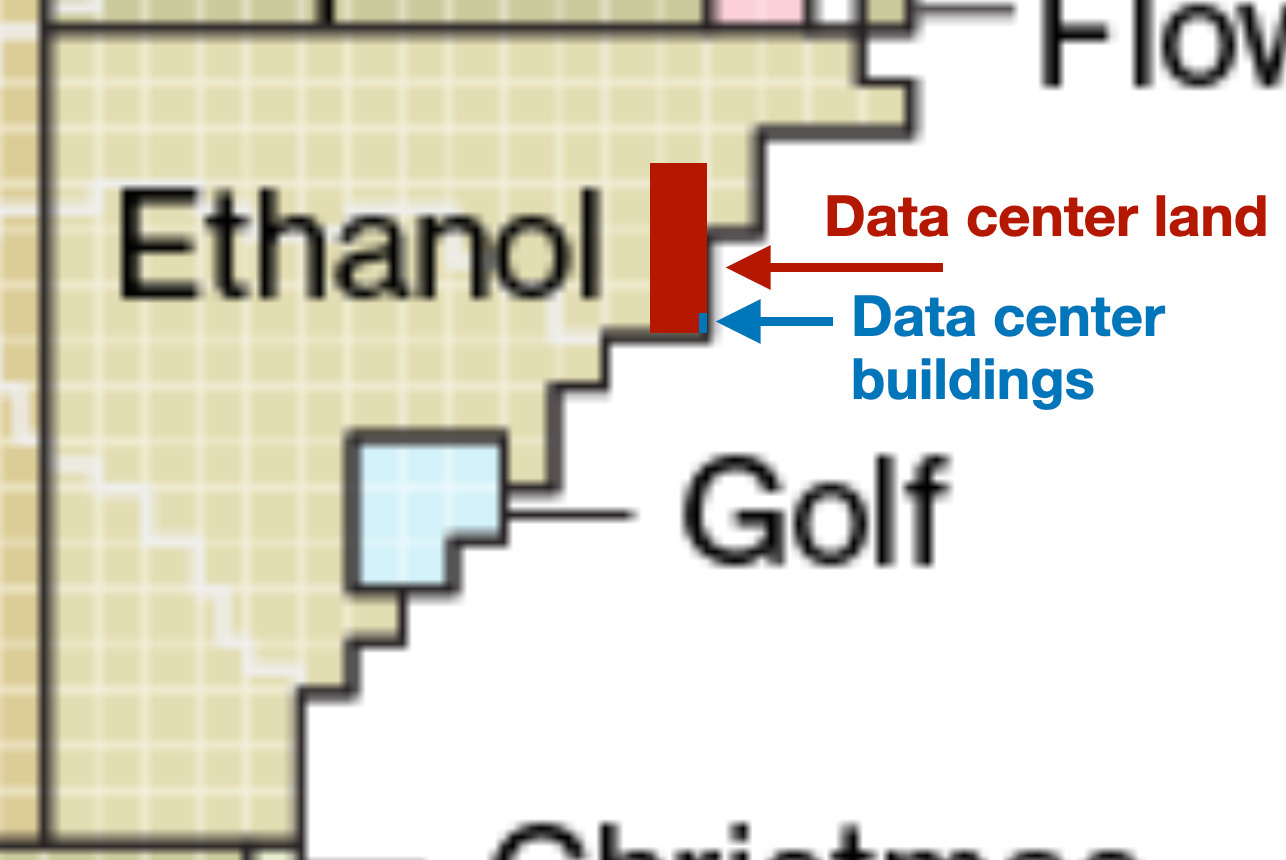
American farmers grow more food than the country eats, export 20% of the surplus, and we the buyers throw out another third of what’s left. Farmers collect $1.85 billion a year from the federal government to keep a Kentucky-sized 40,000 square miles of farmland intentionally idle, an area 28 times the full projected footprint of all land on American data center property in 2028 (with data centers themselves occupying just 2% of that land, just 25 square miles). The federal government forces oil refiners to buy 15 billion gallons of corn ethanol every year, occupying roughly the surface area of New York State, draining aquifers at 40 times the rate of every data center in the country combined, and producing a fuel that, once you account for land-use change and nitrous oxide, is 24% dirtier than the gasoline it replaces. The food we waste, if grown on a single farm, would cover an area 89 times the size of all land owned by data center companies by 2028, and emits as much CO2 as 42 coal plants, 3% of all US emissions. Between 2000 and 2024, farmers sold in total a Colorado-sized chunk of land all on their own, 77 times all land on data center property in 2028, and grew more food than ever on what was left. None of this caused any problems for US food access.
Engineering Problems and Phone Call Problems [Infrastory]
An engineering problem is a problem that requires engineering to solve. A river or a mountain is in the way, or the soil is unstable. These are real constraints, and the job of the engineer is to find a way through, over, under, or around them. That is what engineers are for, and they are very good at it.
A phone call problem is a problem that looks like an engineering problem but isn’t. Another agency controls the right-of-way, a utility needs to be moved, a private company doesn’t want to cooperate, a municipality is being difficult, or a landowner is reluctant to sell. These are human problems. They’re problems of incentive, authority, and will. They have human solutions. But infrastructure projects, which are generally run as engineering projects, have a persistent tendency to treat them as engineering problems instead. The results are predictable and expensive.
Xi’s Forever Purge [Foreign Affairs]
Xi’s focus on self-revolution may also make him less inclined toward major external gambles. Only months ago, he told the Central Committee that “corruption is the greatest threat our party faces”—not the United States, or Taiwan, or even the economy. The recent purges in the People’s Liberation Army, which will make any war harder to fight in the near term, reveal how deeply Xi remains preoccupied with corruption, loyalty, and institutional effectiveness. A leader consumed by domestic discipline and elite governance may pursue a foreign policy that is hard-edged and nationalistic, but he is also likely wary of truly high-stakes risks.
“In particular,” it reads, “[Putin] fears the use of drones for a possible assassination attempt by members of the Russian political elite.”
The report names Sergei Shoigu, former Defense Minister and current Secretary of the Security Council, as a “potential destabilizing actor.”...
A current FSB officer told reporters that his unit was having trouble obtaining wiretapping authorization for criminal investigations because “all the equipment has been redirected to monitor the government and other state bodies.”
One of the Most Prominent Findings in Political Science Might Be Wrong [3Streams]
Headlines based on the above research, such as “The Politics of Always Ignoring What Average Americans Want’’ and “Politicians listen to rich people, not you,” may have produced serious political consequences. If groups are repeatedly told that their voice does not matter, they may decide that it’s not worth it to be involved with politics.
Ironically, research that incorrectly concluded the economic majority and women have no influence may have reduced these groups’ political engagement — perhaps actually reducing their influence…
But the voices of average citizens still matter. My analysis shows that even after controlling for the preferences of business interests and mass-based interest groups, policy responds to the public’s preferences. More political engagement is the way to combat political inequality.
The Parasocial Style in American Politics [Liberal Currents]
While social media changed the intimacy with which people could feel their affections and resentments for politicians, elected officials and candidates are at least meant to be mass public figures. They do at least play a daily, immediate role in the welfare and direction of the country. But as we’ve seen with the rise of Twitter, YouTube, and TikTok influencers, our modern media environment enables us to fashion cults of celebrity and parasocial attachments for anyone on the social web. Frequently, the feelings we assign to these individuals are wildly, terrifyingly out of proportion to roles they play either in public life or—more importantly, perhaps—our own personal lives…
I’ve argued before, with evidence behind me, that our screens short- circuit the critical pathways we have for truly recognizing another person. In this context, the parasocial relationships—the fandoms and anti-fandoms—we cultivate online are always already deficient in the empathy and mutual recognition that make genuine human relationships function. A democracy full of other characters, protagonists and antagonists, rather than fellow citizens is hardly a political society at all. It’s only the idea of one.
The Web gazes also into you [ctrl+shifted]
But for plenty of other computer applications, it seems that user identity has often crept thoughtlessly into systems simply because the technology and the programmer culture has inherited the practice from tech giants. We may learn fundamentals of programming languages and algorithms from schools, but we learn to write complex software by using the coding tools and practices helpfully open-sourced by Big Tech. It seems the only thing we know how build anymore, or at least the only thing that it occurs to anyone to build using a computer anymore, is surveillance tech.
Rent: A New Framework [Liberal Currents]
These measures are not anti-market. They are anti-monopoly. They are not anti-economic. They are anti-exploitation. We as liberals must reject the premise that defending the market economy against central planning requires accepting the status quo of extraction. A market built on rent is not a free market. It is a toll booth economy—one in which the rents flow upward, the costs flow downward, and the gap between them is called prosperity. It is long past time to set the market free.
The Vindication of Bidenomics [Paul Krugman]
Granted, stock prices rose substantially under Biden, and stock ownership is highly concentrated at the top. So the Biden economy was K-shaped in that sense. But if you think about it, it’s hard to see how rising prices for stocks, which are both bought and sold mainly by the richest 10 percent of the population, hurt those below.
So wage inequality fell dramatically during the Biden years. Is income inequality now rising again under Trump? There are faint hints in the data to that effect, but no more than that so far. One thing we do know, however, is that the force Dube identifies as the strongest driver of wage compression — a “tight” labor market — has largely disappeared.
Also from Krugman:
Is Europe in Economic Decline? [Paul Krugman]
Europe, then, is not a museum to its past glories. It is not poor. In terms of current measures of living standards, it is not falling behind the U.S. And, more to the point, given the destruction that Trump II is inflicting on the U.S. economy, it is a safe bet that overall living standards in the U.S. will fall relative to Europe in the near future.
Europe’s productivity keeps outpacing the US [Informer]
And if we use the data to calculate productivity growth (GDP per hour worked), it turns out that, far from lagging the US, Europe is gaining on it: its productivity was 92%, 94%, and 94% of the US level in the early 2010s, late 2010s, and 2020s, respectively — figures that rise to 96%, 97%, and 98% if we use ILO hours data, which are likely more comparable.
Rental Prices and the Cost of Living in the United States, 1914–2006 [NBER]
The findings have direct implications for policymakers and institutions that rely on inflation measurement. Because shelter is the largest component of the CPI and because rents inform costs for both tenants and owners, persistent understatement of shelter inflation can materially affect measured real wage growth, real interest rates, and long-run assessments of living standards. If shelter costs rose by more than previously thought, enough to meaningfully affect overall inflation across nine decades, then in real terms living standards also rose by less. These issues are not merely historical: debates about rent stickiness, vacancy resets, and the conceptual treatment of owner-occupied housing remain central to how inflation is perceived and how policy is communicated.
In this post, I compute the maximum rate at which an autonomous AI economy could grow, once its production is concentrated in the sectors most important for self-replication. I take the conservative case for this calculation: full automation, but no other technological improvement. Using US input-output data, I find this economy could double in about a year, in line with other estimates that assume full automation (Hanson (2001); Trammell and Korinek (2023); Davidson and Hadshar (2025); Epoch AI (2025)). This holds up even after accounting for resource depletion and construction lags. Some output goes to consumption rather than reinvestment, which slows things down, but even moderate savings rates imply doubling times below two years.
Barack Obama Considers His Role in the Age of Trump [New Yorker]
Soon, Obama became the face of a California ballot measure, called Proposition 50, that would allow the legislature to create five new Democratic districts in the state. “With Prop 50, you can stop Republicans in their tracks,” he said in one ad. Strategists tested his reputation alongside those of other well-known Democrats. “Not even close,” Addisu Demissie, a senior adviser to the Prop 50 campaign, said. “His favorability was 89–10, with seventy-five per cent very favorable. Jesus Christ is probably 93–7.” The measure passed by a margin of nearly two to one.
Increasingly feel like “Is Barack Obama a popular American politician?” is one of those basic political cognitive tests we could administer. A surprising number of people insist on getting the answer wrong!
Finally, I really enjoyed this video about how throwing is distinct to human physiology.