Links for May 18th, 2026

This week from me at TVO: a piece about the Auditor General’s recent report about the use of AI in government, asking citizens to think critically about the negatives and potential positives of AI use in the public sector:
So, as citizens we need to answer a simple question: how much do we want the government to be able to do with the information we provide to it? There might theoretically be any number of advantages for the government if we allowed it to feed all the information it already has into high-performing LLMs — an AI agent could proactively reach out to citizens to recommend services and benefits they didn’t even know they were eligible for — but it could just as easily become a dystopian surveillance nightmare. Siloing some, perhaps most, types of data might be “inefficient,” but could also be a basic guarantee of our privacy rights.
And then I found myself getting quite cranky about the Ontario Liberal Party’s latest drama and what it foretells about a party that can’t take its internal failures seriously:
Assuming the Ford government doesn’t revise the province’s electoral boundaries, there will be 124 seats to contest in the next election. The Liberals, as the smallest recognized party in the legislature, have only 12 incumbents. The party’s constitution limits the ability of the leader to simply appoint candidates, so it’s fair to say the Liberals will need to hold something like 100 nomination races between November and the next election, and that timeline is compressed if Liberals want their candidates to have several months (or even a year) before a likely election in 2029.
That was always going to be logistically difficult for what is still the legislature’s third party, but it was the party’s own stated priority. Scarborough Southwest is the first byelection since the 2025 election, so it was absolutely vital that — totally ignoring the Erskine-Smith drama for a moment — the nomination race be executed cleanly and competently, or at least well enough that the party could credibly claim it was prepared to do the work ahead of it. Instead, the party appears to have administered the contest with all the order and dignity of a kindergarten field trip to a candy factory.
And on the podcast, Steve and I talk about the fallout from the Scarborough Southwest Liberal nomination and I take a very long walk to get to a Godzilla joke:
Elsewhere:
Gen Z Is Pioneering a New Understanding of Truth [Wired]
Previous generations inherited relatively stable systems for determining what was real: newspapers, universities, scientific institutions, courts, and professional journalism. Those systems were imperfect and often exclusionary, but they provided shared reference points. Gen Z has inherited something fundamentally different: an information ecosystem where truth is increasingly shaped socially, emotionally, algorithmically, and now synthetically through AI.
As journalist Maria Ressa warned in her Nobel Prize acceptance speech, “Without facts, you can’t have truth. Without truth, you can’t have trust. Without trust, we have no shared reality, no democracy.”
But Gen Z may already be building something to replace what’s been lost. Not institutions. Not gatekeepers. A distributed, socially negotiated sense of who earns the right to be believed. They’re not abandoning truth. They’re auditing who gets to deliver it.
This is actually horrifying! This is nothing more than the small-town rumour mill mass-produced on a global scale, with all of its bigotries and superstitions. It should be something we wage constant, unceasing war against if we want to preserve a rational, liberal society. (Which is, on some days, exactly the debate we seem to be having.) For all the (many!) failures of previous generations of mass media we need ways of knowing about the world that allow us to pause and — for the love of God — think about what is, and what we want.
it’s not that news articles and social media don’t have their place — of course they do. the problem arises when we mistake a combination of news & social media for a complete information environment…
one aspect of this is taking our emotional response to new information and redirecting our energy away from grief & outrage toward archival & categorization. to be clear: i’m not saying you can’t have emotional responses to things. but you must understand, if the magnitude of rage expressed on social media every day translated to anything lasting or durable, the state of affairs would be quite different. right? so what we have to learn to do is take the news, especially the news we feel strongly about, and not just ask, “how does this make me feel?”, but “how can i use this?” what are the important parts, and which parts are useless & irrelevant? can i add the important things to some other context, a page or a list, which increases their usefulness?
another aspect is that we should not only be resisting things that draw our attention but intentionally taking “attention-negative” actions. people can just say anything. but things that are useless must be discarded, not reflected upon. if a known bigot says something horrible and bigoted Again, the correct course of action is to add that thing to their file, not rage about it on social media for the day, or even to point and laugh. you need maybe, like, 2 reaction posts made in total, before working together with each other to file it away and move on to something new.
RIP social media. What comes next is messy. [Ars Technica]
Most social media platforms slightly shifted politically to the right, although they remained Democratic-leaning on balance—except for Twitter/X. In that case, “The engagement behavior was a 72 percentage point shift to the right, which is just insane,” said Törnberg. “It used to be that the more you posted on Twitter, there was a slight correlation with how much you liked the Democrats and how much you disliked Republicans—how effectively polarized you were to the left. Now it’s very strongly and very clearly correlated with hating Democrats and liking Republicans. So the graph appropriately becomes an X, which I guess is exactly what [Elon Musk] paid for.”
Safe and cozy in your doomsday bunker [Garbage Day]
There were years where Instagram and Reddit (and viral listicles) were basically just glorified galleries of tweets. But the internet is different now. Short-form videos are king. And Bluesky’s video features are still very bad. Videos have to be under 100 MB, which is extraordinarily small. So not only can Bluesky users not upload short-form videos from other platforms, they can’t meaningfully post original content that could then be shared to other platforms. The end result is an internet where everyone else is talking about short-form videos and the digital cul-de-sac of Bluesky is talking almost entirely to itself.
You may think, as I do, that short-form video is a scourge, but if the entire internet has settled on a new atomic unit of attention and Bluesky can’t support it on a technical level, they’re going to be, by definition, left out of the conversation.
Clipping’s origins go back at least to 2022, when the influencer Andrew Tate deployed members of his fan club to post clips of his podcast on social media, causing so many people to wonder who he was and why he was clogging up their feeds that he briefly became one of the most Googled people on earth. Since then, and especially over the past year, clipping has gone professional. Dozens of agencies now offer the service to paying customers. Many operate out of public view, inside members-only communities — which I found were not so hard to join — on platforms like Discord and Whop, where they recruit regular people to do the posting. Each community functions as its own marketplace. An agency announces a new campaign, specifying where the clips should run (usually TikTok, Instagram, and YouTube) and what they pay (usually $1 or $2 per thousand views). Members then have a few days to make and upload as many clips as they can, hoping at least one will go viral. A clipper who posts a single video might earn nothing if it flops or thousands if it hits. The founder of one agency tells me his top clipper has earned over six figures publishing across thousands of accounts.
The VRA Was the Nice Version [Build a Better Donkey]
There are two ways this gets resolved:
Door one is elected officials using every lever the system still gives them to restore a bargain in which participation actually produces results.
Door two is what’s happened every other time in human history that a critical mass of people figured out their participation was decoration.
This isn’t a call to violence. It’s a call to play hardball, fill the streets, and embrace ambitious and aggressive reform.
Anything less is to miss the moment. It’s to stand flat-footed as history happens to us. And anyone so inclined should either come to their senses or get out of the way. This American republic, however you want to define it, has fallen. A revolutionary moment is here, and the future belongs to those who are willing to seize it and set the course of the nation.
The American Right Dared To Imagine. Now It’s Our Turn. [Bad Faith Times]
Do you understand how heavy a lift it was to gut the Voting Rights Act? It took decades of placing the right (wrong) people in power and weaponizing bad-faith legalism to destroy one of the great achievements in the history of western democracy. You would have been laughed out of the room if, in the late 90s or early 2000s, you said the Supreme Court would nullify the VRA by 2026. You gotta hand it to these right-wing ghouls for imagining the return of Jim Crow and following through on it. This took tremendous political imagination.
Reaching the Breaking Point [First Branch Forecast]
The HFC knows what it wants and is willing to fight for it. During speaker election fights and the removal of Speaker McCarthy, its members demanded to be treated like part of a governing coalition as if the faction were a small party. The HFC even prepared an orientation document for incoming Republican members for the 118th Congress that articulated a clear-eyed view of how power has moved into the hands of leadership and how they would use that power to control the chamber unless caucus members worked together to change the governing rules and structures. Here’s their topline bullet point: “The leaders of both political parties have consolidated so much power that most Members of Congress have no meaningful role in the legislative process beyond voting up or down.”
This declaration of relevancy for the rank-and-file struck most congressional observers as chaos and disorder, of a petulant minority breaking norms and rules. What it really represented was the start of a tectonic shift within the chamber back to a multi-factional system without domineering leadership control of the legislative process. We cannot judge whether the Freedom Caucus meant what they said. The result of their successful political maneuvers, however, was to swap leadership control with factional domination of the agenda, in this case, the minority-of-the-minority.
IEA Head Calls on Canada to Move Faster on Energy Amid Supply Shock [Bloomberg]
Typically, countries buy energy based on price. But in the aftermath of the Iran war, “there will be an energy security risk premium,” Fatih Birol, the IEA’s executive director, told a policy conference in Toronto on Thursday. As a result, “the most important resource, or card, that Canada has today is trust.”
He acknowledged the country has a reputation internationally for lengthy timelines on major projects, in part because of its multiple levels of government. “Canada doesn’t have the luxury to be slow,” he said, noting that many factors have come together to create a “golden opportunity” for the country.
“The cost of missing this train will be incredible,” he said.
On the death of RCP8.5 [The Climate Brink]
The brutal math of climate change is this: as long as CO2 emissions remain above zero, the world will continue to warm. The medium scenario ends up closer to 3.7C by 2150, while the high scenario ends up more or less matching the warming in the old RCP8.5 scenario despite an assumption of flattening or modestly declining emissions after 2100.
It is also wrong to say that the worst predictions of climate impacts this century can now be ruled out by this revision. High-end temperature projections for the end of the century are reduced compared to earlier IPCC assessments. Yet, the IPCC WGII report found that risks across the five “reasons for concern” it examines have all risen for a given level of global warming. So, even if the high-end emissions in RCP8.5 won’t materialize, the damages projected in these earlier climate simulations remain very much in play.
What Happens When Americans Realize How Miserable We Are? [Paul Krugman]
Take the issue of life expectancy, which surely matters as much as GDP. After all, one important contributor to the quality of life is not being dead…
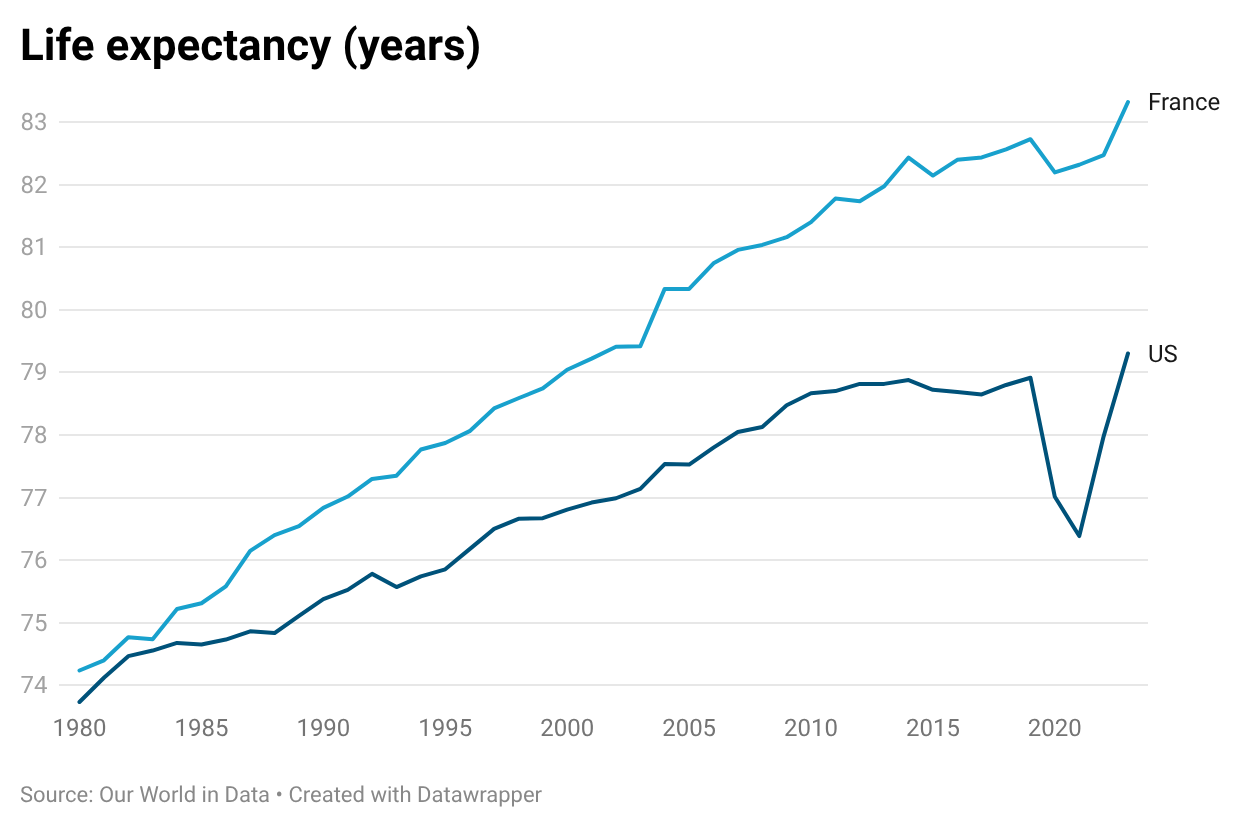
But there are many ways in which America’s quality of life is much worse than one would expect given the nation’s wealth. And we should always remember that economic growth is supposed to be the foundation of a better life. A nation that has high GDP per capita but whose citizens live worse than their counterparts in other countries is not a success story.
And many Americans would, I believe, be angry if they realized how much worse our lives are in many ways than those of our counterparts abroad.
The difference between US COVID deaths and basically all other peer nations is so staggering. Yet you will still see people with large platforms argue that the US response to COVID was merely mediocre and not outright scandalous.
While we want to be careful not to extrapolate too much from these few episodes, we suspect that the post-COVID price spike was uniquely shocking to consumers relative to historical antecedents. Note that the variance in yearly CPI inflation from 1960-89 was 7.7 percent, whereas the inflation rate’s variance since 1989 has only been 1.7 percent. In other words, in recent decades — in part due to the success of the Federal Reserve in anchoring inflationary expectations — consumers simply hadn’t experienced much in the way of price shocks or price volatility. On the other hand, consumers in the 1970s had experienced both the steady rise of inflation from the mid 1960s to 1973, as well as the price spike of 1973-74. Inflation spiked in November 1974, reaching 11.5 percent; consider that someone 18 years of age at the time of that spike would only have been 23 in 1979. Someone 18 years old in 1979 would have been 61 in 2022. Nobody under the age of 43 in 2022 would have been alive during the last time inflation breached 7.5 percent, much less actively participating in the economy.
In other words, the results from this part of our research underscore that one cannot begin to understand how people experience price changes by simply looking at the ups and downs of yearly inflation, especially around a shock. It is also essential to account for people’s memories and expectations, not solely with respect to the monthly or yearly change in prices, but also regarding price levels. It is also important to account for their longer-term experiences of price movements. Our findings suggest that a huge storm after a long calm can be more upsetting to people who are not used to bad weather.
We tested one of the media’s favorite economic theories [The Argument]
Inflation hit everyone, which resulted in widespread economic pessimism. But, as Darling noted, the shocks were especially magnified among services that relied on low-cost labor — particularly services that higher-income households had become accustomed to. This explains why the vibecession gained even more traction: It was especially sharp among the upper class that traditionally tends to shape discourse in this country.
Darling’s thesis is the first compelling explanation I’ve seen for the vibecession. Importantly, it is not rooted in “social media vibes.” Instead, it provides a real, coherent explanation rooted in material cost increases, and it is not centered around baseless chatter on TikTok acting as a social contagion on the economy.
The Vibecession Hasn’t Gone Away [Matt Darling]
I think that this is an important component in understanding the vibecession. Part of what might be happening is just that - after decades of low inflation - Americans were especially frustrated by the sudden rapid increase. Another is that the way the media reports the economy shifted. Work by Ben Harris and Aaron Sojourner suggests that not only were households more negative than expected in the last few years, but media reporting was also similarly odd…
I think part of what happened is that many middle- and upper-income households were used to being able to afford low-wage labor on demand - for childcare, for food service, for home health care. Middle- and upper-income households found this frustrating and assumed it was part of the broad story throughout the economy; not realizing that much of this frustration was driven by low-wage workers finally earning a little more bargaining power.
Tokyo land is still >$85 million an acre [The Abundance and Growth Blog]
The famous (relative) cheapness of Tokyo housing is not a story about cheap land. A one-acre detached house in central Tokyo would cost more than $100 million in dirt before you broke ground. The land is pricey but the structures are cheap. Admittedly, Tokyo’s rents and prices are not as cheap per square foot as buildings in the US Sunbelt’s midsize cities, but cheap by the standards of any 10-million-plus Anglosphere metro area. Tokyo built its way to relative affordability without ending up with low land values, and the values themselves look reasonable for a productive, agglomerated megacity that simply didn’t artificially restrict its own supply.
Learning to Love Growth [The Freeman]
That is all familiar to us, with the housing crisis an increasingly mainstream policy question. And much as it has contributed to an acute housing affordability problem, it is mostly innocent. The vast majority of “NIMBYs” today are not motivated by a conscious Malthusianism. But some of their forbears were, and they, and we, should understand that America’s housing crisis is in part downstream of an anti-human, anti-growth ideology…
It could hardly be clearer that at least some of these advocates understood restrictions on housing construction as an actual policy lever to engineer lower population growth. For people like Robert Fellmeth and Boulder’s chapter of the (it should be noted, Paul Ehrlich-founded) Zero Population Growth organization, suppressing housing construction appears to have been the point, not merely an unfortunate downstream effect.
Can new studio apartments open more homes for families? [Pencilling Out]
In this article, I review some recent economic literature on this question, which provides evidence that new development will likely ease pressure on all kinds of existing housing — even if the new housing is not family-sized. I also show new data on the meaningful numbers of childless, college-educated households living in family-sized housing. The presence of yuppies in family-friendly housing further shows that these different categories of housing are closely linked, and building new housing of any kind could help families.
Mexico builds its own state-sponsored EV [Driving.ca]
Called the Olinia, a word which apparently comes from the Nahuatl or Aztec word ‘ollin’ meaning ‘movement,’ it is a small low-cost electric vehicle intended for urban use and could be offered in numerous different bodystyles. The tall, boxy shape shown in a promotional video would certainly maximize interior space, as would the clamshell doors and apparent lack of B-pillar. Another version intended for cargo transport is also in the works.
Forget for a second whether this is a desirable use of government power. In Ontario, companies who have tried to sell similar vehicles have struggled to even get them certified for legal use on provincial roads (ie, all of them.)
Both the AI+ plan (September 2025) and 15th Five Year Plan (March 2026) stated clearly that made AI’s labor impact explicit at the highest level of state planning, and AI shall “accelerating empowerment across all industries”. When the state is the principal subject of that future, the things a Chinese tech company should do, should think about, should not do, and should not think about are settled by this inexplicit social contract…
In China, the viable agency to steer the future is the state, and state capacity absorbs AI differently. AI in China is not seen as an elite technology to be contained, nor as an anti-egalitarian threat. It is seen as the state’s instrument of Darwinian upgrade — and the instrument does not get to interpret itself. That work belongs to whoever holds the mandate. The companies build. The state then decides what it has been built for.
Chinese green technology poses national security problem for Europe, report warns [Financial Times]
Among the greatest was supply chain disruption, according to the authors, who argued that China was likely to restrict supply of low-carbon technology and components. Beijing has increasingly used export controls in recent years to leverage its control over global supply chains.
But:
An under-appreciated risk was that the US could demand Europe remove Chinese technology from its energy systems — or face tariffs, sanctions or reduced security commitments, according to the report. It noted that the UK banned Chinese telecoms equipment maker Huawei from supplying kit for Britain’s 5G mobile phone networks following intense pressure from the US.
This is not a Chinese security risk! It’s a “US is run by paranoid nationalist weirdos” risk! In any event, the Chinese security risk is substantially overstated:
The United States cannot slow its grid expansion, leave it undefended, or decouple it from PRC supply chains overnight. Smart strategic planning means addressing the most serious vulnerabilities first. Not every component in America’s rapidly digitizing grid carries equal risk. Treating the entire electricity ecosystem as if everything is an emergency means that nothing will be defended effectively. And imposing blanket restrictions on all Chinese-made components would throttle the very industrial buildout the United States needs to outpace current PRC manufacturing advantages.
Anyway, the American security risks in re: China are a lot more direct than sneaky chips embedded in batteries, heat pumps, and solar panels.
Is the United States Prepared for a War with China? [CSIS]
In multiple wargames conducted by CSIS, the U.S. military exhausted its inventory of some types of long-range missiles within the first week of a Taiwan conflict. Taiwan used up its entire inventory of antiship cruise missiles after a week as well. It would be impossible to sustain a fight without long-range weapons. Chinese defenses are formidable—especially in the early stages of a war—and would make it difficult for U.S. aircraft or ships to maneuver close enough to fire short-range munitions.
On Superpower Suicide [Timothy Snyder]
The war can lead us to a diagnosis of superpower suicide. Wars cannot be won by people who have no idea what they are doing, because they have no frame of reference (such as the nation or the state) beyond their own feelings. They cannot be fought well when the wrong people are making the daily decisions and the wrong weapons are being deployed. They cannot be reasonably brought to an end when there is no practice of diplomacy and no notion of the value of alliances and no concern about corruption.
Services on the Supply Side [Forces of Production]
Interestingly, goods-production employment has changed significantly less than service-provision employment has over the past thirty-five years. It did fall, by 10 percent, while the service sector added nearly twenty times as many jobs as the goods-producing side lost.
Looking at the employment transition over time, the role of the business cycle stands out the most. During expansions, service-providing industries add jobs while goods-producing employment largely holds steady. When recession hits, employment in service-providing industries holds steady while the goods-producing industries lose jobs. It is also interesting that even as the share of employment in goods-producing sectors fell precipitously, the absolute number of jobs on the goods producing side has remained relatively range-bound.
The Protein Shortage Is Coming [The Atlantic]
Turning fresh, raw cow’s milk into the shelf-stable, scoopable, tasty-enough protein powder people want is a massively complicated process, one that requires space and time and huge, expensive machines. At one point while Polzin and I were talking, I suggested that one of these machines might cost, say, $100,000. Wrong, Polzin told me—try millions. A full processing plant can cost up to $1 billion to build, he said. “Everything is just big numbers.” Even if you had, theoretically, started raising capital for a dairy-processing facility the day the word protein-maxxing first appeared on Reddit—three years ago—it would unlikely be up and running today.
Whey shortage, meet just one of many companies looking to fill the gap:
Canadian startup Opalia has secured C$3.2M ($2.3M) in the first close of a funding round to expand production of its cell-based dairy and pursue regulatory clearance in North America.
…It has established an immortalised bovine mammary cell line, which means it doesn’t need to harvest any more tissue from the cow. It grows its cells in bioreactors and induces lactation to produce the full composition of milk – including proteins, fats and sugars – in a similar downstream process to that of cow’s milk.
Unlike precision fermentation, which companies use to produce bioidentical dairy proteins or fats, Opalia’s serum-free cell-based process delivers milk as a ready-to-use product, not an ingredient.
Getting regulatory approval to sell this in Canada will be interesting, in the context of dairy supply management. My understanding is that it won’t legally be marketable as milk, even though it’s derived from cow mammary cells.
And if you wanted a four and a half hour history of the invention, construction, and regulation of the electrical power grid boy does the Stepchange podcast have you covered: (via David Roberts.)